Is a more perfect union still possible?
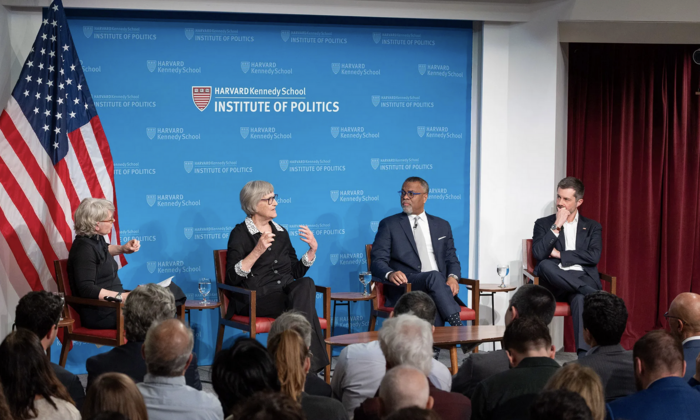
During a talk Monday evening at Harvard Kennedy School, a panel of American history scholars and political analysts discussed the forces of the present and the past animating the country’s divisive political climate and whether there remains a path to a more perfect union.
Drew Faust, a Civil War historian and president emerita of Harvard, and Eddie S. Glaude Jr., a scholar of African American studies and religion at Princeton, said in many respects the schism in today’s U.S., which often feels like a loosening confederation of Red and Blue states, can be traced back to the North/South divide over slavery during the Civil War.
In fact, social scientists and economists have noted the persistence of political and economic differences that remain between former Union and Confederate states.
While there is much ideological and sociological overlap, Glaude cautioned against leaning too heavily on that geographic dichotomy to fully explain the current partisan rift because it “overburden[s] the South” and “feeds the myth that the moral problem resides there, as opposed to in the heart of the nation.”
Read more in the Harvard Gazette